GLM-5.3-Flash vs Opus 5: Which AI Model Should You Use?

By Alex Morgan
MyClaw Editorial
MyClaw
Run Best-in-Class AI Agents Now
Run OpenClaw or Hermes Agent on managed MyClaw hosting, so your AI agent stays online, updated, and ready for real work.
Start HostingAI Takeaway
- Which model is stronger for difficult work? Claude Opus 5 has the better-supported case for demanding coding, research, and long-running agent tasks, especially when judgment and self-verification matter more than cost. That does not make it the winner for every workload.
- Which model offers better value? GLM-5.3-Flash wins decisively on token price and offers MIT-licensed weights. Its durable list rates are $0.15 per million input tokens and $0.50 per million output tokens, versus $5 and $25 for Opus 5.
- Do benchmarks identify a universal winner? No. Shared results are limited, and many published tables use different harnesses or compare GLM with Opus 4.8 rather than Opus 5.
- What is the practical recommendation? Use GLM-5.3-Flash for repeatable, high-volume work; use Opus 5 for ambiguous or costly-to-fail tasks; consider routing work between both.
GLM-5.3-Flash vs Opus 5 at a Glance
This is a price-and-control versus capability-and-risk decision. GLM-5.3-Flash offers near-frontier benchmark results at dramatically lower API rates, plus an open-weight deployment path. Opus 5 costs much more, but its strongest case is not one leaderboard score. It is the evidence for deeper reasoning, deliberate verification, and sustained performance on difficult work.
| Category | GLM-5.3-Flash | Claude Opus 5 |
|---|---|---|
| Best fit | High-volume agents, cost-sensitive coding, controlled deployment | Difficult coding, deep analysis, high-stakes autonomous work |
| Context | 1M-class | 1M |
| Inputs | Text, images, video, and files | Text, images, and PDFs |
| API list price | $0.15 input / $0.50 output per 1M tokens | $5 input / $25 output per 1M tokens |
| Weights | MIT-licensed open weights | Proprietary |
| Self-hosting | Supported through runtimes including SGLang and vLLM | Not available |
The word “Flash” can be misleading here. This is not a tiny model: Z.AI describes a mixture-of-experts system with 320 billion total parameters and 18 billion active parameters. The earlier GLM-5.2 model guide provides useful context for how the family has developed around long-context engineering and open deployment.
Performance: What the Evidence Actually Shows
Coding and Long-Horizon Agent Work
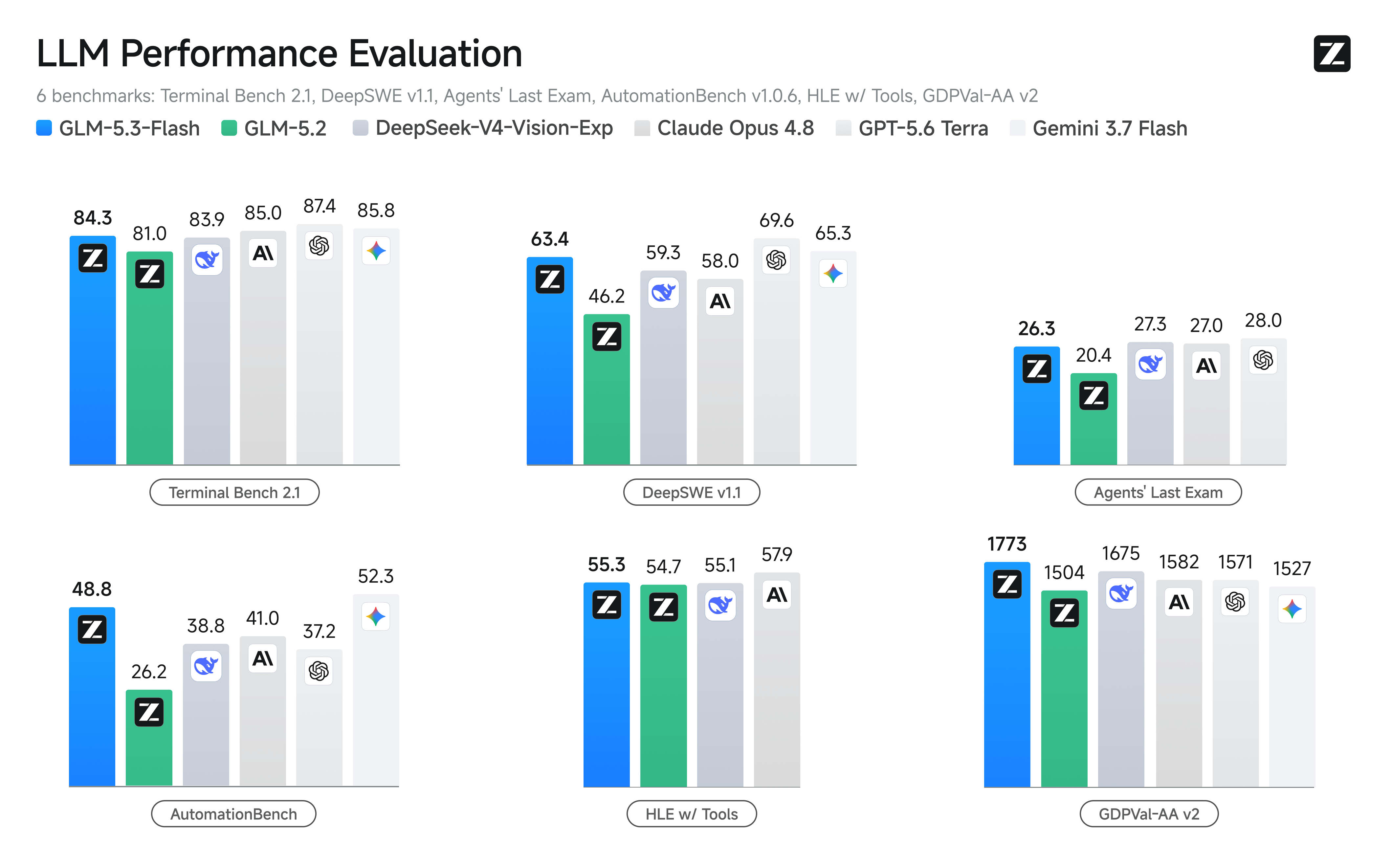
Z.AI's launch table puts GLM-5.3-Flash close to Claude Opus 4.8 across several coding and agent evaluations. GLM leads that older Opus release 63.4 to 58.0 on DeepSWE, 78.4 to 76.2 on Toolathlon Verified, and 48.8 to 41.0 on AutomationBench. It trails 84.3 to 85.0 on Terminal-Bench 2.1 and 55.3 to 57.9 on HLE with tools. These are strong price-performance signals from Z.AI's evaluation setup—not proof that GLM matches Opus 5.
In Anthropic's Frontier-Bench setup, Opus 5 more than doubles Opus 4.8's performance at a lower cost per completed task. Anthropic's early-access reports also emphasize root-cause analysis, codebase-wide changes, numerical reasoning, and careful verification. The Claude Opus 4.8 guide helps establish the baseline Opus 5 improves upon.
The evidence supports a risk-based starting point, not a universal ranking. Put GLM first when the task is clear and success is easy to check. Put Opus first when the model must challenge an assumption, repair an incomplete plan, or decide whether its own output is safe to ship.
Tool Use, Vision, and Long Context
Both models target tool-using, multimodal agents with roughly one million tokens of context. GLM-5.3-Flash is Z.AI's first natively multimodal GLM-5 model and is designed for browser and computer workflows. Opus 5 also works with images and is positioned for coding, computer use, professional analysis, and long-running agents.
A large context window is capacity, not reliability. Loading a repository, documents, screenshots, and tool logs into one request does not guarantee that every constraint will remain equally important. Test retrieval, instruction retention, and final verification on the longest tasks you actually run.
Why Headline Scores Do Not Line Up
Benchmark results change with the agent harness, reasoning effort, time limit, tool permissions, context management, and number of attempts. Vendors also select different tasks and baselines. A composite leaderboard can hide those differences and create precision that the evidence does not support.
Use the OpenClaw AI model benchmark as an operational reference, then validate the shortlist with your own tasks. Completion rate, correction time, and successful tool use are more useful than a synthetic “overall intelligence” score.

Cost per Token Is Not Cost per Completed Task
At durable list prices, GLM-5.3-Flash charges $0.15 per million input tokens and $0.50 per million output tokens. Z.AI launched it with a temporary 50% discount—$0.075 and $0.25—that ends on September 9, 2026. Opus 5 costs $5 per million input tokens and $25 per million output tokens.
For a run using 100,000 input tokens and 10,000 output tokens, GLM costs about $0.02 at list price. Opus 5 costs about $0.75 before caching, platform fees, or tool costs. That 37.5× gap matters when an agent handles thousands of routine jobs.
But a cheap failed run is not cheap. If GLM needs repeated prompts, human repair, or an Opus review to finish a difficult task, its token advantage narrows. Conversely, paying for Opus on extraction, classification, or predictable formatting can waste money without improving the result.
Opus 5 offers adjustable effort and a Fast mode that runs about 2.5 times the default speed at twice the base token price. GLM's sparse architecture targets efficiency, but observed latency still depends on the provider, hardware, context length, and serving load. Compare wall-clock time and completed-task cost, not token rates alone.
Open Weights or Managed Frontier Model?
Choose Control With GLM-5.3-Flash
MIT-licensed weights let you choose the serving stack, infrastructure location, scaling policy, and data boundary. That can be decisive for regulated workloads, private environments, or sustained volume where API margins dominate the budget.
Open weights do not make deployment free or simple. A 320B-total MoE checkpoint still demands serious hardware planning, quantization choices, monitoring, upgrades, and inference expertise. Hosted GLM access may be more economical until utilization is high and predictable.
Choose Simplicity With Opus 5
Opus 5 is available through Anthropic and supported cloud platforms, so your team can focus on prompts, tools, evaluation, and application logic instead of operating inference infrastructure. The tradeoffs are provider dependence, proprietary weights, higher unit pricing, and provider-defined safeguards.
This makes Opus attractive when engineering time is expensive and failures are costly. GLM becomes more compelling when control, scale, and unit economics are first-order requirements.
Which Model Should You Choose?
Pick GLM-5.3-Flash When
Choose GLM for extraction, routing, multimodal document processing, routine code changes, frequent subagent calls, or any workload where outputs can be checked automatically. It is also the clear candidate when open weights or self-hosting are mandatory.
Pick Opus 5 When
Choose Opus for unclear requirements, architectural decisions, difficult debugging, code review, financial or professional analysis, and long-running tasks where the agent must notice that its original plan is wrong. The premium is easier to justify when one missed edge case costs more than the entire model bill.
Use Both When
A hybrid system often has the best economics. Let GLM triage requests, gather context, draft outputs, and execute routine tools. Escalate low-confidence results, failed checks, unusual cases, and high-impact decisions to Opus. Use the MyClaw model directory to compare currently listed agent models, but confirm access to these newly released model IDs through your chosen provider before designing the route.
Build an evaluation set of 20–50 representative tasks. Track successful completion, human corrections, retries, wall-clock time, and total cost. Re-run it after model or price changes. This produces a routing policy grounded in your work rather than somebody else's leaderboard.
Test Both Models in an Always-On MyClaw Workflow
MyClaw provides managed hosting for private, always-on OpenClaw agents, so the evaluation can include persistent files, tools, and repeated runs instead of isolated chat prompts.
- Launch a managed OpenClaw instance. Select a hosting plan that matches the runtime resources you need, then keep the environment stable.
- Confirm access and run matched tasks. Connect a compatible provider or BYOK setup that exposes the required model IDs, hold prompts and tools constant, and record quality, time, retries, and cost.
- Route work by measured difficulty. Send proven routine jobs to GLM-5.3-Flash and escalate failed, ambiguous, or high-stakes work to Opus 5. Recheck the policy whenever capabilities, availability, or prices change.
Final Verdict
Start with GLM-5.3-Flash when failure is cheap, detectable, and easy to retry. Start with Opus 5 when a weak plan or missed edge case is expensive. If your workload contains both conditions, measure completed-task cost and route by risk instead of forcing one model to handle everything.
Skip the Setup, Run Best-in-Class AI Agents Now
Launch a managed OpenClaw or Hermes Agent workspace in minutes, with always-on hosting, updates, and support handled by MyClaw.
Get Started