GPT-6.2 Astra vs Fable 5.2: Coding, Pricing & Verdict

By Julian Brooks
MyClaw Editorial
MyClaw
Run Best-in-Class AI Agents Now
Run OpenClaw or Hermes Agent on managed MyClaw hosting, so your AI agent stays online, updated, and ready for real work.
AI Takeaway
- Which should you choose? Test Astra first for cost-sensitive professional workflows. Shortlist Fable for difficult coding and open-ended research, where its stronger results may justify more spend.
- Which is better for coding? Fable leads Cognition’s native-agent comparison; a separate Artificial Analysis evaluation puts the models much closer. The execution setup matters.
- Which costs less? Standard API rates match at $8 input/$40 output per million tokens. Actual bills differ through token use, caching, retries, and Astra’s long-context premium.
- How can MyClaw help? Build cloud-based AI teammates for development, research, and review, each with its own role, tools, and supported model. Choose models for the work each teammate handles.
GPT-6.2 Astra vs Fable 5.2 at a Glance
The practical choice is between quality at the tested settings and the cost of producing it. Astra is a strong candidate for repeated business assignments; Fable merits a trial for difficult repository changes and research involving judgment. This comparison uses official specifications and published evaluations, without claiming original testing.
The API specifications below were checked on November 18, 2026. Prices are USD per million tokens.
| Detail | GPT-6.2 Astra | Claude Fable 5.2 |
|---|---|---|
| API model ID | gpt-6.2-astra | claude-fable-5-2 |
| Context window | 1,050,000 tokens | 1 million tokens |
| Maximum output | 128,000 tokens | 128,000 tokens |
| Standard input / output | $8 / $40 | $8 / $40 |
| Base cached input | $0.40 | $0.20 |
| Input → output | Text and images → text | Text and images → text |
Astra separately caps input at 922,000 tokens. Its 1.05M context figure includes room for output; it is not a 1.05M input allowance. Neither context limit measures how reliably the model will use every detail.
For teams using the earlier OpenAI flagship, our Claude Fable 5.2 vs GPT-6 Astra comparison covers that older choice. The figures below refer specifically to Astra 6.2.
Coding and Research: What the Evidence Shows
Coding: Compare the Model and Its Tools
Cognition’s FrontierCode 2.0 tests whether code changes meet maintainers’ standards. Its live leaderboard, checked November 18, reports:
| Model and Effort | Agent Software | Weighted Score | Mean Cost per Attempt |
|---|---|---|---|
| Fable 5.2, xhigh | Claude Code | 50.2% | $17.73 |
| GPT-6.2 Astra, max | Codex | 44.2% | $5.97 |
Fable scores 6 percentage points higher, at roughly three times the cost per attempt. Those costs include unsuccessful runs; they are not prices per accepted change. The score is a weighted rubric result, not a pass rate. The difficult migrations and extended debugging covered in our Claude Fable 5.2 review are useful trial jobs.
A separate Artificial Analysis implementation uses its own Stirrup agent software. It reports Fable at high effort with default fallback at 49.1%, versus Astra at xhigh at 49.0%. Do not mix these scores with Cognition’s table: the setups differ. Together, they support testing Fable on hard coding work without assuming its lead survives every configuration.
Professional Work: Astra’s Efficiency Case
OpenAI reports Astra leading Fable by 5.5 percentage points on Agents’ Last Exam at 5% of Fable’s task cost. The evaluation covers multistep professional work; Fable’s results exclude nine tasks that used a fallback model.
That makes Astra worth trying for recurring reports, spreadsheets, and other business deliverables. The saving is specific to this evaluation. Check whether the output satisfies your brief before applying the cost advantage to your own workload.

Open-Ended Research and Judgment
Epoch’s November 17 evaluation shows why a broad benchmark lead may not transfer to your work. Despite roughly tied Epoch Capabilities Index scores, Astra averaged 65% on Epoch’s work tasks, 17 points below Fable 5.2. No evaluated model met Epoch’s employee standard on any task.
In its data-center analysis task, Astra omitted useful estimates because it wanted additional confirmation, even though Epoch judged the available evidence sufficient. Fable performed better on the core research, while still needing revisions.
Fable is therefore a useful candidate for research requiring justified assumptions under incomplete information. Epoch’s small set of internal tasks does not establish a universal research winner. For your report, check completeness, source quality, and whether the conclusion resolves the question you asked.
API Pricing: Equal Rates, Different Task Costs
The shared $8/$40 base rates make token consumption central to this comparison. A model that reasons longer, delegates work, or repeats failed attempts can cost more even when the rate card matches.
Long context creates a separate difference. Above 272,000 input tokens, Astra doubles input and cache rates and multiplies output rates by 1.5 for the full request.
Fable includes its full context window at standard rates under ordinary global pricing. For large document collections, this difference can matter even before reasoning and retries enter the bill.
Consider a hypothetical request with 300,000 uncached input tokens and 10,000 total billable output tokens, including reasoning:
- Astra: 0.3 × $16 input + 0.01 × $60 output = $5.40.
- Fable: 0.3 × $8 input + 0.01 × $40 output = $2.80 at standard global rates.
This illustration holds token counts constant. The same prompt can produce different counts across models. It excludes cache writes, tool charges, hosting, and premium modes.
Fable’s lower cache-read rate can help repeated-context work, but savings depend on cache hits, write charges, and retention. Measure the initial run and follow-ups together.
For a useful comparison, divide total model and tool spend across all attempts by the number of accepted tasks. Record human correction time separately. API charges, app subscriptions, and hosted-workspace plans cover different things.
The Claude Fable 5.2 vs Opus 5.5 decision follows the same rule: pay for more capability only when it improves accepted work enough to cover the extra cost.
Test Both Models Before Changing Your Workflow
Choose three representative tasks: a repository change, an evidence-based report, and something your current setup handles poorly. Define success first. A patch might need to reproduce the bug, pass relevant tests, and preserve neighboring behavior; a report might need reconciled figures and traceable evidence.
Keep files, permissions, tools, and output requirements comparable. Start each trial from equivalent context, rather than letting the second model inherit the first model’s solution.
Record the runtime as well as the model. The OpenClaw vs Codex comparison explains why execution tools and workflow choices matter. If those differ, you are comparing complete setups as well as models.
Specify effort instead of relying on defaults. Matching labels does not guarantee equal computation. Compare the settings each model needs to meet the same quality target and spending limit.
Repeat within a fixed budget and record accepted outputs, elapsed time, total spend, and manual corrections. Include failed and unfinished attempts. For example, a report that omits the requested analysis has consumed budget without delivering an accepted result. Switch only when the improvement covers migration and maintenance.
Build Your AI Team with MyClaw
You may want different models for different jobs: a software engineer working through a migration, a researcher checking evidence, and a reviewer examining the result. That makes the next decision how to organize the work across AI teammates.
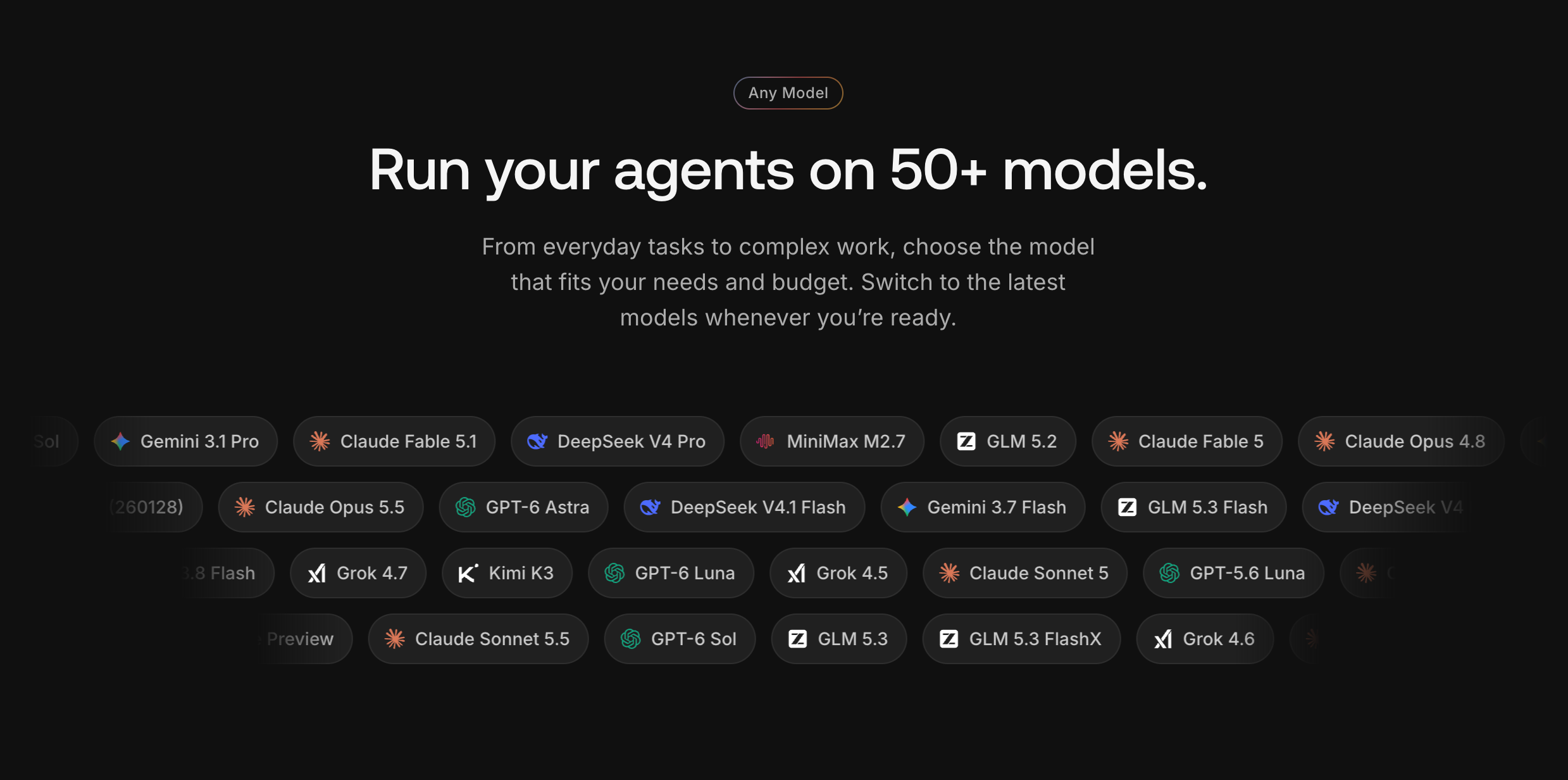
MyClaw brings those teammates together in the cloud. Each can have its own role, runtime, tools, and skills. Supported runtimes include Claude Code, Codex, OpenClaw, Hermes Agent, Pi, and DeepSeek Harness. Connected apps and shared memory provide context across your agents, while their cloud computers let work continue after you close your laptop.
Use the comparison above to configure teammates around their responsibilities:
- Give Each Teammate a Clear Job. Start with a role template or define your own. For a coding agent, provide the repository, expected change, and checks that establish success. Set up a separate research role when the work needs source gathering and analysis.
- Choose the Runtime and Model. Select the execution environment that suits each role, then confirm its available model versions. Use Astra or Fable where your trials show a benefit; keep a cheaper model for simpler work. Model choices depend on the selected runtime.
- Connect Tools and Delegate the Work. Add the apps, files, and skills each teammate needs. Assign a concrete deliverable, review the result, and make successful workflows recurring where useful. Check MyClaw pricing for current Credits, runtime options, and usage terms before budgeting the team’s work.
Conclusion
Start with Astra when the priority is efficient professional work, and test Fable when difficult coding or research needs more capability. Published results support those trials, while the smaller gap in a separate coding setup shows why the model’s tools and settings belong in the decision.
Compare finished work, total spend, and correction time before switching. With MyClaw, you can configure AI teammates around different responsibilities and choose supported models for each role. Give one real assignment to each candidate under documented conditions, then use the results to decide which model deserves the next job. Keep a cheaper option where it already delivers.
Skip the Setup, Run Best-in-Class AI Agents Now
Launch a managed OpenClaw or Hermes Agent workspace in minutes, with always-on hosting, updates, and support handled by MyClaw.