GPT-6 Sol vs Astra: Which Model Should You Choose?

By Julian Brooks
MyClaw Editorial
Compare in MyClaw
Compare GPT-6 Sol and GPT-6 Astra on your own work
Run the same hard job in both models to compare quality, recovery, speed, and cost before choosing a stack. Neither is an automatic default.
AI Takeaway
- Which model should you try first? Start with GPT-6 Sol for demanding everyday coding and agent work when you need to control cost. Try Astra for the hardest jobs or when Sol repeatedly fails a clear acceptance test.
- How much more does Astra cost? At Standard short-context API rates, Astra costs five times as much per input or output token: $10/$50 per million, versus Sol's $2/$10. A finished task may use different numbers of tokens and attempts.
- Does Astra offer a larger context window? No. Both models list a 1,050,000-token context window and 128,000 maximum output tokens. Capacity alone does not establish how accurately either model uses long context.
- How do you make the final choice? Run both on the same job with the same tools and pass/fail rule. Count accepted results, retries, elapsed time, review effort, and total spend.
GPT-6 Sol vs Astra at a Glance
These are two distinct models in the GPT-6 family. GPT-6 Sol is not GPT-5.6 Sol, the older model used as a baseline in some Astra launch comparisons. Check the exact API ID before interpreting a price or benchmark.
| Detail | GPT-6 Sol | GPT-6 Astra |
|---|---|---|
| API model ID | gpt-6-sol | gpt-6-astra |
| OpenAI's positioning | Complex coding and agentic workflows | Most capable model for the hardest end-to-end work |
| Standard input / output, per 1M tokens | $2 / $10 | $10 / $50 |
| Cached input, per 1M tokens | $0.20 | $1 |
| Context window / maximum output | 1,050,000 / 128,000 tokens | 1,050,000 / 128,000 tokens |
| Reasoning effort | none, low, medium, high, xhigh, max | low, medium, high, xhigh, max |
| Input / output | Text and images / text | Text and images / text |
Sol's default API reasoning effort is medium; Astra does not offer none. Both can use tools through the Responses API. The prices above are direct API rates for Standard processing and short-context requests. ChatGPT and Codex subscription limits work differently, and hosted-agent infrastructure costs are separate.

Coding, Tools, and Long Context
Coding and complex reasoning
Sol is designed to handle code and agent workflows that require judgment across several steps. Think of a bug that spans three files: the model must locate the cause, make a narrow fix, run the relevant test, and explain any remaining failure. Sol is a sensible first candidate when that sequence already works reliably at its lower price.
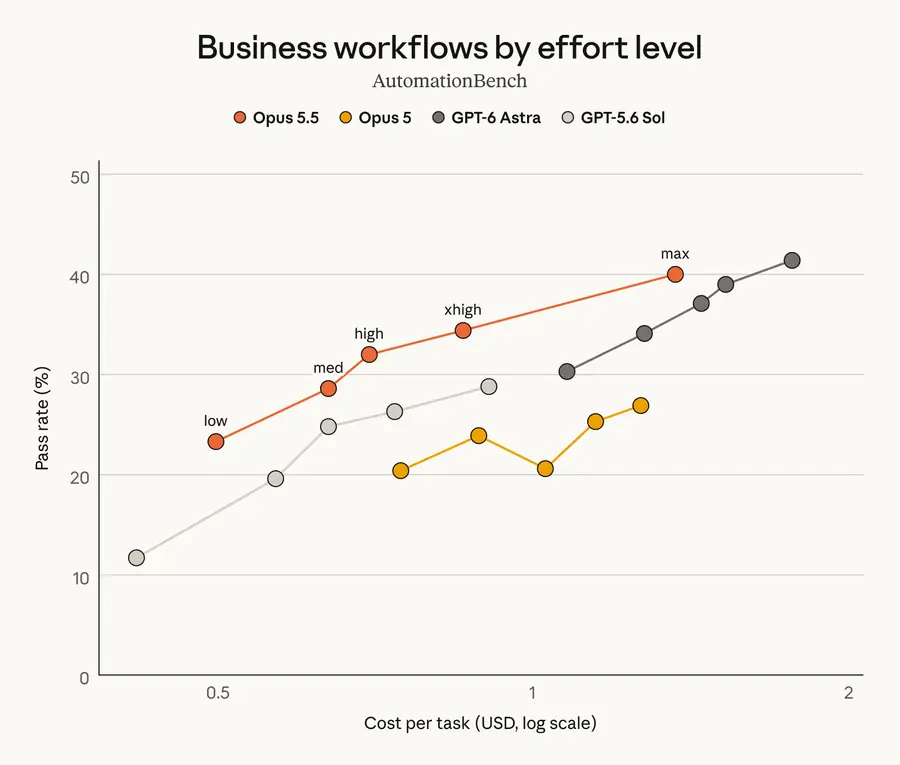
Astra is OpenAI's highest-capability option for unusually difficult, ambiguous work. Consider it when the fix requires tracing unfamiliar code, reconciling conflicting requirements, or recovering from multiple failed approaches. MyClaw's Astra model page details its specifications and use cases. Its older benchmark comparisons use GPT-5.6 Sol, so those scores are not a GPT-6 Sol head-to-head result.
Published benchmarks can suggest where to test, but they cannot establish a universal winner. Scores depend on the task set, tools, and reasoning setting. For a research job, check whether both models find the decisive evidence and resolve contradictions; for code, inspect the patch and test results. A fluent explanation does not make an incorrect artifact successful.
Tool-heavy agents and long context
An agent's result depends on more than its model. It needs access to the right files and apps, appropriate permissions, reliable tools, and a way to recover when an action fails. A coding-agent workflow is a useful example: the measurable outcome is a working change, not merely a plausible patch suggestion.
For API integrations, use the Responses API when evaluating reasoning with tools. Astra requires it for tool calling. Sol supports function calling in Chat Completions only when reasoning_effort is none, so an app needing tool calls at higher effort must use Responses. Test the complete workflow rather than a bare chat prompt.
Both models can accept a very large context, yet a 1.05M-token limit tells you how much can fit, not whether the model finds and uses the decisive passage. In a matched test, include a decisive fact deep in a long file and check whether each model uses it correctly. Include only relevant context: extra input can raise cost, especially beyond the 272K pricing boundary.
GPT-6 Sol vs Astra Pricing: Tokens and Finished Tasks
What a matched request costs
At Standard short-context API rates, Sol costs $2 per million uncached input tokens, $0.20 for cached input, and $10 for output. Astra costs $10, $1, and $50 respectively. Cache writes cost $2.50 for Sol and $12.50 for Astra. Each category has the same fivefold price ratio.
Suppose one request uses 100,000 uncached input tokens and 10,000 billable output tokens. Sol costs $0.30: (0.1 × $2) + (0.01 × $10). Astra costs $1.50 for those same counts. This equal-token example excludes cache writes and tool fees; it does not predict either model's actual token use. Reasoning tokens count toward billable output. For recurring agents, the OpenClaw token-cost guide helps identify repeated context and improve caching.
Long inputs change the rates. Above 272,000 input tokens, OpenAI applies long-context pricing to the entire request. Sol then costs $4 per million uncached input tokens and $15 per million output tokens; Astra costs $20 and $75. Cached-input and cache-write rates also rise. Batch or Flex processing halves the applicable Standard rates; Fast mode doubles them. Keep the processing tier fixed when comparing invoices.
When the higher price can still make sense
The practical unit is an accepted result, including retries and correction. Using the illustrative request above, four identical Sol attempts cost $1.20 in model tokens; one Astra attempt costs $1.50. Six Sol attempts cost $1.80. The second case makes Astra cheaper in token spend if it succeeds on the first attempt, even before counting review time. In practice, attempts will rarely use identical token counts, so measure them.
Astra may be worth more when its stronger reasoning saves enough failed calls, tool work, or human repair. Conversely, a job Sol completes on the first pass has little reason to absorb Astra's higher rate. Do not assume either outcome from a price table or a launch benchmark.
When to Choose Sol or Astra
| Situation | Sensible next test |
|---|---|
| Repeatable job with clear checks; Sol already passes | Keep Sol and record its ongoing cost |
| Sol is close but misses a reasoning step | Try a higher Sol effort setting, then compare cost and accuracy |
| Ambiguous, multistep task with repeated Sol failures | Test Astra on the same inputs and acceptance rule |
| A task succeeds but consumes many slow retries | Test whether Astra reduces total spend or review time |
The same label—say, high—does not promise equal compute, latency, or quality across models. Nor is max automatically the best economic setting for Sol. Choose the smallest configuration that reliably meets your quality bar, and escalate only when a harder task earns it.
The GPT-6 Astra review gives more background on the flagship model. For this decision, collect fresh results with gpt-6-sol and gpt-6-astra specifically.
Test Both Models on One MyClaw Agent Job
MyClaw provides managed hosting for a private, always-on OpenClaw agent. That keeps a workspace and runtime available for a repeatable job; the selected model still determines how the agent reasons within it. Check that your deployed workspace exposes both exact model IDs before planning a direct switch. Hosting charges and model usage are separate parts of the decision.
Step 1: Pick a measurable job
Choose one task with a definite finish line: repair a failing test, produce a sourced comparison from a fixed set of files, or reconcile numbers in a report. A task Sol has already struggled with is especially informative. Write the acceptance check before either run.
Step 2: Run Sol and Astra under matching conditions
Give each model the same prompt, files, tool permissions, and output requirements. Record the reasoning setting, elapsed time, tokens, tool failures, and any intervention. If Sol misses narrowly, try a higher Sol effort and compare its cost and quality with Astra's. Do not substitute GPT-5.6 Sol for an unavailable GPT-6 Sol ID.
Step 3: Keep the better operating choice
Check the final artifact against your rule, then total the model and tool spend plus the time needed to repair mistakes. Keep Sol for routine tasks it completes well. Route the harder cases to Astra when its measured improvement justifies the extra cost. Recheck that choice as your workflow, model access, or pricing changes.
Compare in MyClaw
Compare GPT-6 Sol and GPT-6 Astra on your own work
Run the same hard job in both models to compare quality, recovery, speed, and cost before choosing a stack. Neither is an automatic default.