Muse Spark Open vs Kimi K3: Open Weights Compared for 2026

By Alex Morgan
MyClaw Editorial
MyClaw
Run Best-in-Class AI Agents Now
Run OpenClaw or Hermes Agent on managed MyClaw hosting, so your AI agent stays online, updated, and ready for real work.
AI Takeaway
- What exactly is Muse Spark Open? It is Meta's open-weight release of Muse Spark, with 816B total and 42B active parameters and room for a million tokens of context, published on October 15, 2026 under the Muse Model License (vendor-stated).
- What is Kimi K3? It is Moonshot AI's flagship, launched on July 16, 2026, with 2.8T parameters, native vision and a million-token window. Moonshot says the full weights followed by July 27, 2026, licensed through its own Kimi K3 terms (vendor-stated).
- Which one has the lower API price? Moonshot's list (July 16, 2026) shows $3 for each million uncached tokens sent in and $15 for each million generated. Hosting partners list Muse Spark Open at $1.25 and $4.25 (third-party listings, October 2026), so check current rates.
- Which one is simpler to run yourself? Neither is simple. Meta points to a four-GPU Blackwell node for its 4-bit checkpoint, while Moonshot suggests supernode setups of 64+ accelerators for K3 (vendor-stated).
- Where can I use one without running servers? Meta's hosting partners serve Muse Spark Open, and Moonshot's own API serves Kimi K3. If you would rather have a hosted agent than pick a model yourself, the MyClaw section near the end explains that option.
Muse Spark Open vs Kimi K3: The Short Verdict
Both are open-weight models built for coding and agent tasks, yet they sit at different scales. Kimi K3 is the larger flagship, while Muse Spark Open is a smaller sparse model that Meta says can run on two high-end Mac Studios. Neither vendor compares the two directly, and we ran no tests of our own, so this review sticks to published specs, licenses and prices, each labelled with its date.
For background on the closed original, start with our write-up on Meta's Muse Spark.
| Muse Spark Open | Kimi K3 | |
|---|---|---|
| Maker | Meta | Moonshot AI |
| Released | October 15, 2026 | July 16, 2026 (weights by July 27) |
| Total parameters | 816B | 2.8T |
| Active parameters | 42B | about 104B (technical report) |
| Context window | About a million tokens | About a million tokens |
| Inputs handled | Text, pictures, video, audio | Text plus vision |
| License | Muse Model License | Kimi K3 License |
What Muse Spark Open Is
"Open" here means the downloadable, open-weight version of Meta's own Muse Spark. It is not a separate model family. Meta describes it as built for coding and agentic work, natively multimodal, with text output only. The weights come as BF16 and NVFP4 checkpoints, and Meta added extra safety post-training because open weights run without the guardrails of a hosted product.
You can call it through partners that Meta names, including Baseten, Fireworks, Groq, Modal, Nebius, OpenRouter and Together, or download the weights from Hugging Face and other clouds. Meta says the license has "limited commercial terms" that let many developers use the model for free. For how the Muse line relates to Llama, see our Muse Spark versus Llama comparison, and for the earlier release our Muse Spark 1.3 post.

What Kimi K3 Is
Moonshot calls Kimi K3 its most capable model and the first open model to reach 2.8 trillion parameters. It is built on Kimi Delta Attention and Attention Residuals, with a sparse expert layout. You can reach it in the Kimi app, the Kimi Work desktop app, Kimi Code and the Kimi API, and Moonshot set its launch effort level to the maximum.
Moonshot is candid about limits. It says K3 still trails the most powerful proprietary models overall, that quality can become unstable if an agent does not pass back its full thinking history, that it may make unexpected decisions on ambiguous tasks, and that its user experience lags the top closed models. Our Kimi K3 versus Fable 5 post goes deeper on that comparison.

Specs and Licenses Side by Side
Both models use mixture-of-experts designs, so the real split is size and terms. Kimi K3 carries roughly three times the total parameters and more than double the active ones, which raises serving needs.
Our summary of the licenses, not legal advice, with the Kimi text read directly on Hugging Face on October 16, 2026. Muse Model License: Meta says many developers can use the model free of charge under limited commercial terms. Kimi K3 License: the text on Hugging Face grants broad rights to use, modify, distribute and sell, with added terms for Model-as-a-Service businesses above $20 million in revenue over 12 months, and a "Kimi K3" display requirement for products above 100 million monthly users or $20 million monthly revenue. Moonshot's terms exempt internal use and use through its own products or certified inference partners from those two extra conditions. Read the full text of both licenses before shipping a product.
API Prices and Running Costs
Moonshot's own Kimi API list (July 16, 2026) shows $3 for each million uncached tokens sent in, $0.30 when those tokens come from cache, and $15 for each million generated, at one flat rate across the window. For Muse Spark Open, OpenRouter, Together and Fireworks list $1.25 for input, $4.25 for output and $0.15 for cached input per million (third-party listings, rechecked on OpenRouter on October 16, 2026). OpenRouter also notes that caching often pulls the price actually paid well below list. Together also showed a free promotion through October 18, 2026.
Our own arithmetic, for illustration only: a job that reads one million uncached tokens and writes 100,000 would list at $3.00 plus $1.50, so $4.50, through Kimi's API, versus $1.25 plus about $0.43, so roughly $1.68, through a Muse Spark Open partner. Real bills depend on caching, reasoning length and the provider you choose.
Self-hosting is a different budget. Meta cites roughly 537 GB of weights for NVFP4 and about 1.65 TB for BF16, plus cache and runtime overhead. Moonshot's guidance for K3 is a supernode of at least 64 accelerators.
Coding and Agent Work
Meta says Muse Spark Open handles long-horizon tasks, complex software engineering and multi-step reasoning, and it demoed agentic workflows running entirely on-device. Moonshot reports strong scores on coding, agentic, knowledge and vision suites, plus long autonomous runs such as a compiler build and a chip design.
Treat all of that as vendor material. Each company picked its own benchmarks, harnesses and settings, so a Meta number and a Moonshot number are not comparable. We quote no scores here, because we could not find a neutral head-to-head, and a fair test needs the same tasks on the same harness.
Muse Spark Open vs Kimi K3 Pros and Cons
Muse Spark Open Pros
- Smaller active size and lower listed API rates.
- Takes audio, video and images as input.
- Meta documents a path to run it on two Mac Studios.
Muse Spark Open Cons
- Outputs text only.
- The Muse Model License has limited commercial terms.
- Newer, so independent testing is thin.
Kimi K3 Pros
- Larger flagship with a broad, permissive license.
- Official API, apps and coding tool from the maker.
- Moonshot publishes limits openly.
Kimi K3 Cons
- Much heavier to self-host.
- Generated output is listed at $15 per million.
- Sensitive to thinking history in agent harnesses, per Moonshot.
How to Pick Between Them
Pick Muse Spark Open if you want a smaller model, audio or video input, a lower listed API rate or a path to run it on a desktop cluster. Pick Kimi K3 if you want the larger flagship and the maker's own tools, and its heavier footprint does not worry you.
If you will call an API either way, run the same three real tasks on both and compare results, retries and spend before committing.
A Hosted Agent Alternative: MyClaw
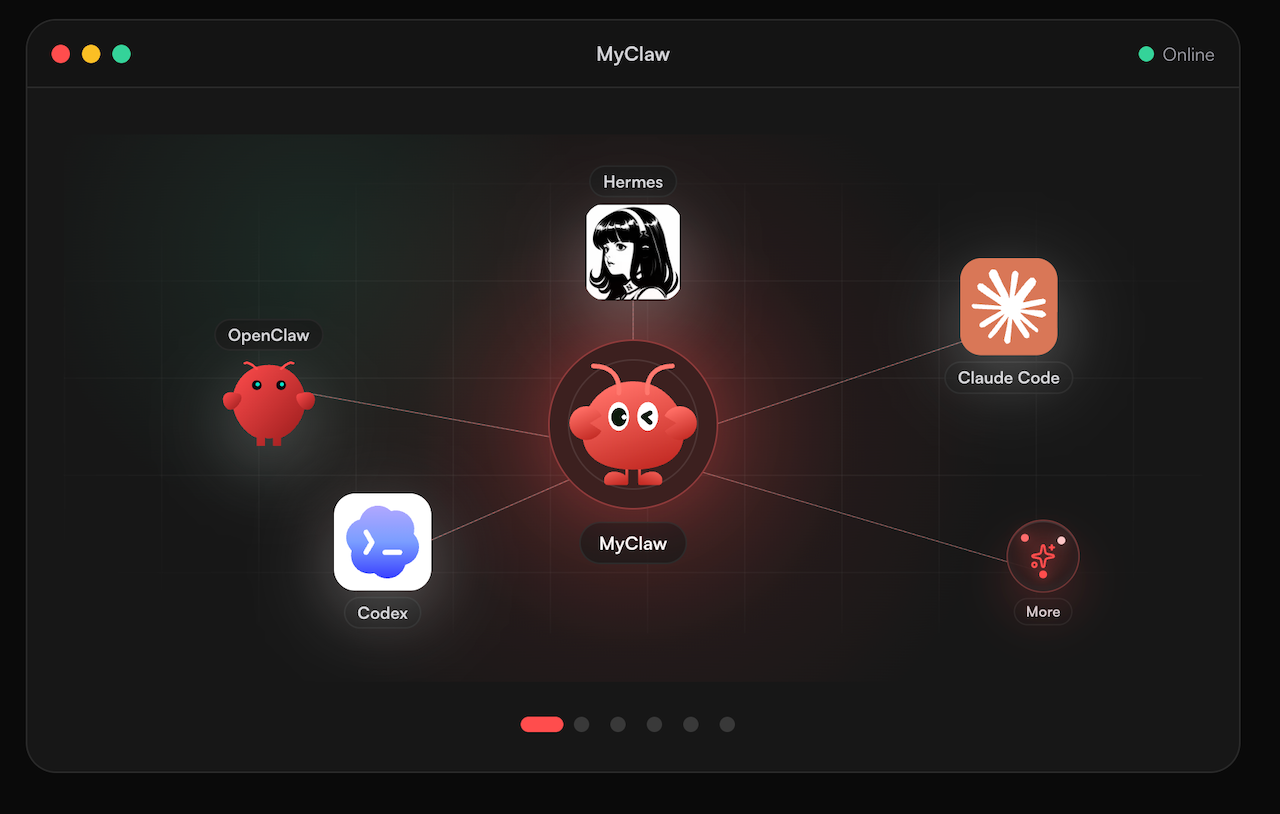
Picking between two big open models is just one decision. Someone still has to host, update and watch whatever you pick. MyClaw takes that part off your plate: it runs managed OpenClaw or Hermes agents that never switch off. You message an agent through a browser, Telegram, WhatsApp or email, and it can link up with your documents, tools and data.
It can also work with most popular models, so you are not tied to a single one. To be plain about cost, MyClaw costs less than Muse Spark, and we leave out exact figures here because they can change. To learn the basics, read what OpenClaw is or our Hermes agent guide.
- Start a hosted agent on MyClaw.
- Once it is running, connect your chat app (with a short test message), then show it which files or tools it may use.
- Hand it one repeating task, such as a daily summary, and see how it goes.
Conclusion
Muse Spark Open and Kimi K3 are both serious open-weight options, but they answer different questions. Muse Spark Open is the lighter, multimodal choice with lower listed API rates, while Kimi K3 is the larger flagship with the maker's full toolset. The honest takeaway is that no neutral test separates them yet. Compare them on your own tasks first. If you would rather skip the hosting work, a managed agent on MyClaw is a gentle next step.
Skip the Setup, Run Best-in-Class AI Agents Now
Launch a managed OpenClaw or Hermes Agent workspace in minutes, with always-on hosting, updates, and support handled by MyClaw.