Particle 1 Reviews: Price, Benchmarks, and AI Coding Tradeoffs

By Olivia Hart
MyClaw Editorial
MyClaw
Run Best-in-Class AI Agents Now
Run OpenClaw or Hermes Agent on managed MyClaw hosting, so your AI agent stays online, updated, and ready for real work.
AI Takeaway
- What is Particle-1? Particle AI’s first API model, launched October 28, 2026: a software-engineering–focused coding agent post-trained on DeepSeek V4.1 Flash to finish tasks with fewer tokens while staying near base-model accuracy.
- What do Particle 1 reviews say about price? Particle’s docs list peak defaults of $0.25 per 1M input tokens and $1.00 per 1M output (cached input $0.03), checked November 2, 2026—bill the channel you actually call.
- Which Particle 1 AI reviews and benchmarks matter? Particle’s launch post cites 28.4%–52.2% fewer output tokens versus DeepSeek V4.1 Flash on four coding/data-engineering suites; Plotly’s October 31, 2026 exam scored Particle-1 40/43 against the base’s 36/43.
- Who should try it? Teams with heavy terminal, repo, and data-engineering agent volume who can validate on their own harness—and who accept closed weights plus best-effort schema output.
- Where does MyClaw fit today? MyClaw hosts always-on OpenClaw/Hermes agents for the models you already have keys for, so overnight jobs keep running while you evaluate Particle-1 separately.
Particle 1 at a Glance
Particle-1 is not a desktop app or a gadget. It is Particle AI’s API model for agentic software work—terminal workflows, codebase edits, and data-engineering tasks—released with the company on October 28, 2026. Particle post-trained it on DeepSeek V4.1 Flash with reinforcement learning and a rank-64 LoRA covering about 1.25% of the base parameters (Particle Blog, October 28, 2026; Plotly restates October 31, 2026). The goal is shorter reasoning and tool-call traces, with accuracy that stays close to the base.
Access is API-only. Particle has not released open weights or the adapter (Plotly, October 31, 2026). OpenRouter’s model card (checked November 2, 2026) lists text and image input, text output, tools and reasoning, a 1,048,576-token context window, and up to 131,072 output tokens. For how the DeepSeek V4.1 Flash family itself splits, see DeepSeek V4.1 Flash vs DeepSeek V4 Pro.

Particle 1 Price
Particle 1 price in these Particle 1 reviews comes from Particle’s Usage & billing docs (checked November 2, 2026). Peak (standard) defaults for particle-1 are $0.25 per million uncached input tokens, $0.03 per million cached input tokens, and $1.00 per million output tokens. Reasoning tokens count as output. Account overrides can apply; the Billing page shows your effective rates.
Off-peak runs (20:30–04:00 America/New_York) and entitled Flex traffic each take another 50% off those applicable token rates. Hosted web search is billed separately at $2.50 per 1,000 searches by default. OpenRouter lists Particle-1 at $0.05 / $0.50 per 1M with $0.003 cache read (checked November 2, 2026)—a channel footnote, not a substitute for Particle’s documented peak list. Build the quote from whichever gateway actually settles your invoice.
Particle 1 Benchmarks and AI Reviews
Most Particle 1 AI reviews that cite vendor numbers start with the October 28, 2026 launch post. On Terminal-Bench 2.1, ReactBench, ADE Bench, and DeepSWE 1.1, Particle reports 28.4%–52.2% fewer output tokens and 34.4%–51.6% lower average cost per task than DeepSeek V4.1 Flash, with Pass@1 inside the base model’s confidence intervals. Outside those training domains, Particle lists GPQA Diamond at 90.40% (base 90.91%), Tau Airlines 86.00% (88.00%), Standard MMLU 86.08% (85.98%), and BabyVision with tools 89.18% (89.60%).
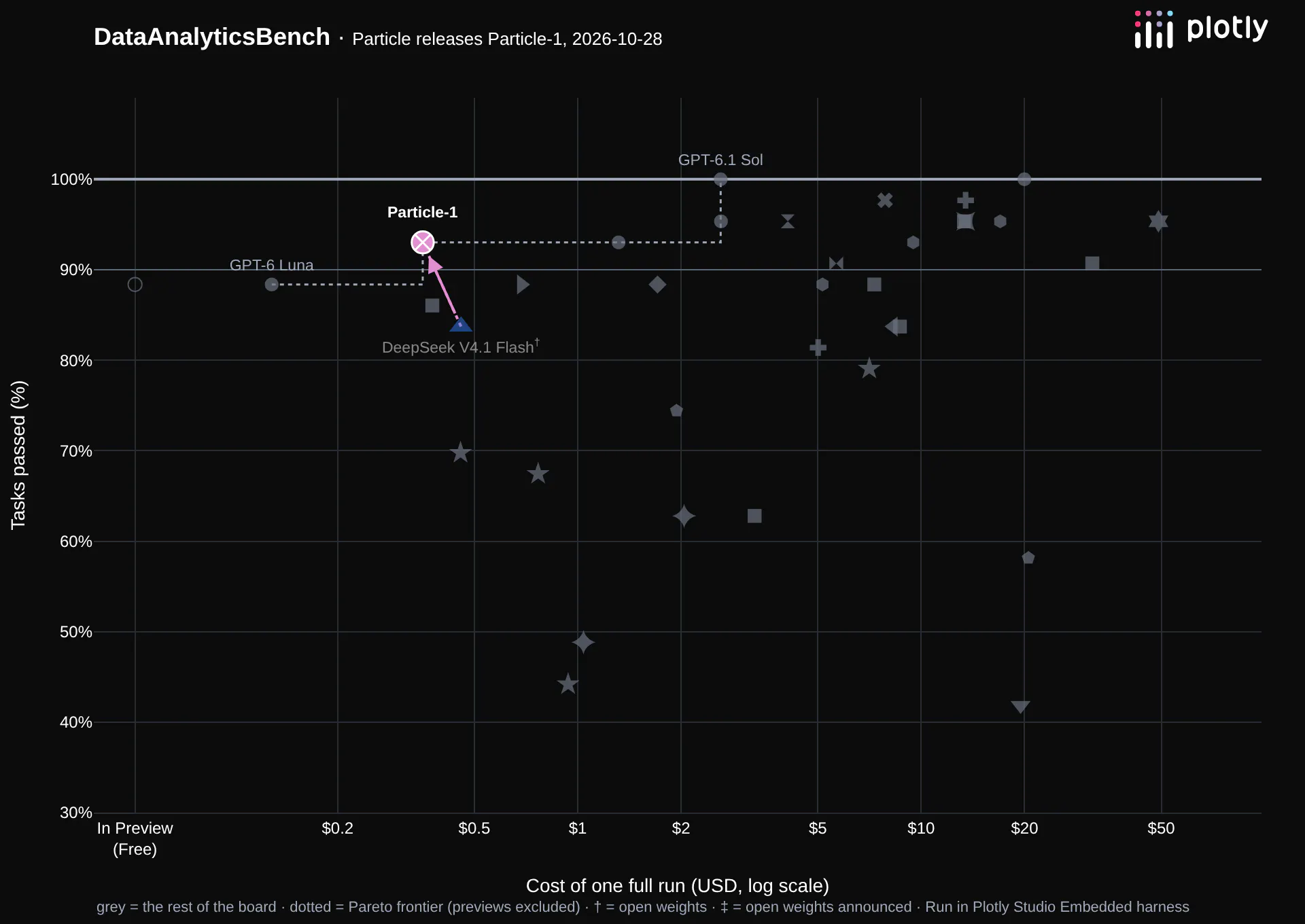
Plotly’s DataAnalyticsBench write-up (October 31, 2026) is the clearest third-party Particle 1 reviews datapoint so far. Particle-1 scored 40 of 43 (93%) versus 36 of 43 for DeepSeek V4.1 Flash; the full Particle-1 exam run cost $0.35 at OpenRouter prices then, tying GPT-6.1 Terra’s 40/43 at a lower Plotly-reported exam cost ($1.31 for Terra). Gains sat on hard items—statistics traps 5/5 versus 3/5, hidden patterns 3/5 versus 1/5—while three misses included a false data-quality alarm and two planted needles. Plotly also notes the shorter-token story did not show on this analytics exam (more output tokens and more calls than the base) and that single-run scores on other models can move by up to about three points. For flash-tier context beside DeepSeek, see DeepSeek V4.1 Flash vs Gemini 3.8 Flash; for agent-stack framing, see OpenClaw vs DeepSeek.
Pros and Cons
Pros:
- Vendor coding and data-engineering suites show large output-token cuts versus DeepSeek V4.1 Flash (28.4%–52.2%) with Pass@1 near the base (Particle Blog, October 28, 2026).
- Plotly’s independent exam lands Particle-1 at 40/43, four points above the base, with a dated OpenRouter exam cost of $0.35 (October 31, 2026).
- Fits agent loops that need ~1M context, tools, image input, and a software-engineering focus for terminal and repo work.
- Peak list price is published on Particle’s billing docs, with off-peak and Flex discounts when your account and window qualify.
Cons:
- Weights and adapter stay closed; self-host means falling back to DeepSeek V4.1 Flash or another open checkpoint (Plotly, October 31, 2026).
- List prices diverge by channel—Particle peak $0.25/$1.00 versus OpenRouter $0.05/$0.50 (both checked November 2, 2026)—so budget sheets must name the gateway.
- Structured output is best-effort for schema-guided decoding; Particle’s docs report
structured_outputs: falseand tell you to validate in the app (docs checked November 2, 2026). - Plotly’s analytics run did not reproduce the shorter-token pattern, so efficiency claims should be re-checked on your own task mix.
Who Should Try Particle 1 vs Who Should Wait
Try Particle-1 if your agents already grind through compiles, patches, dbt-style pipelines, or long repo loops and you can A/B it against DeepSeek V4.1 Flash on the same harness. Measure pass rate, wall-clock time, and tokens per accepted change on a fixed sample of tickets before you flip the default model. A week of paired runs usually beats a single demo chat.
Wait—or keep the base—if you need open weights, gateway-guaranteed JSON schemas, or a single global price you can paste into finance without naming a reseller. Also wait if your workload is mostly fuzzy research or one-shot Q&A: Particle’s published gains sit on coding and data-engineering suites, and Plotly’s analytics exam showed higher accuracy without the shorter traces. In that case, token budgets may not move the way the launch charts suggest.
If the real bottleneck is that jobs die when your laptop sleeps, fix hosting before you chase another model name. Map recurring work with OpenClaw Getting Started, and compare managed Hermes-style options in Best Hermes Agent Hosting.
Run Always-On Agents With MyClaw
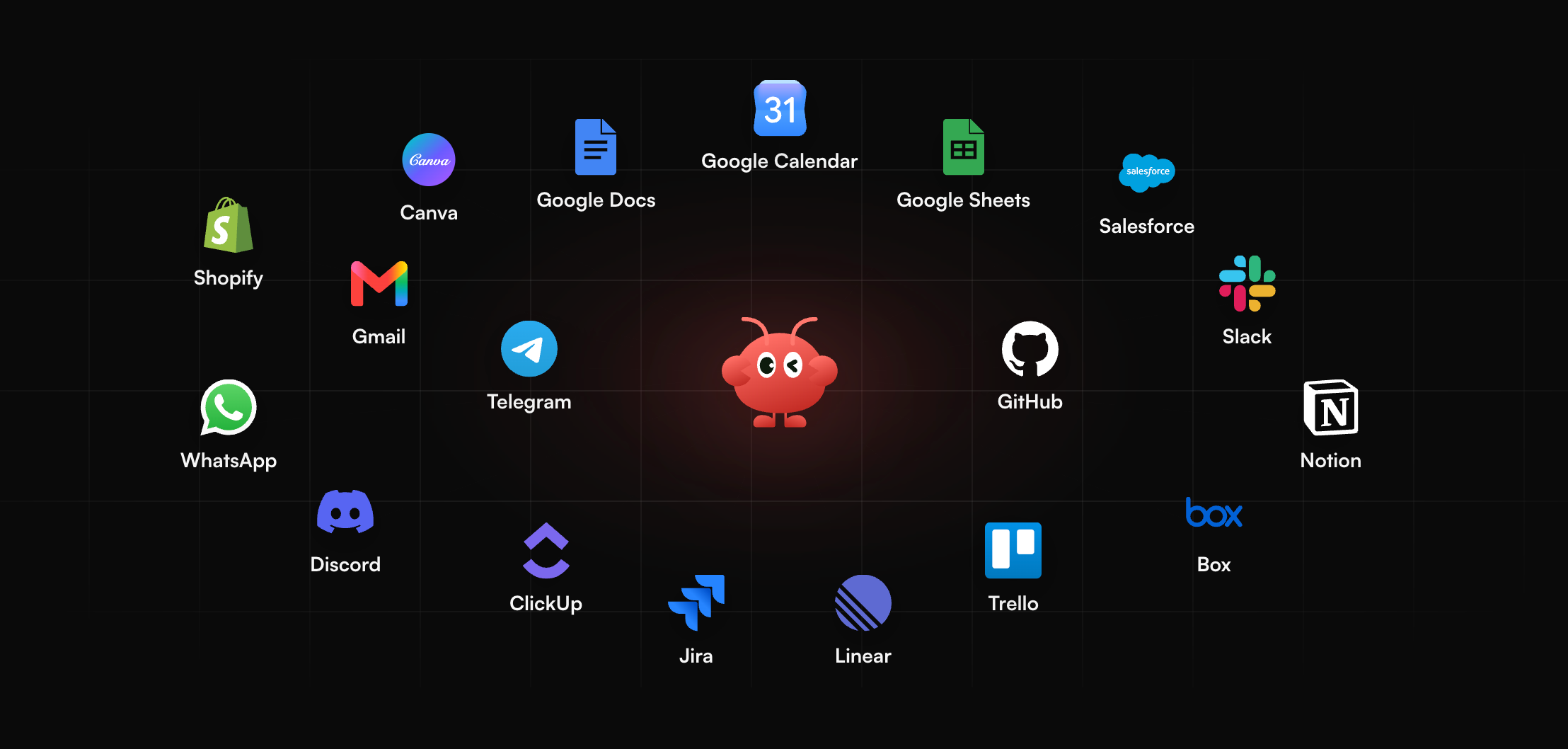
MyClaw is managed OpenClaw/Hermes agent hosting: always on, scheduled jobs, no server for you to babysit. It works with most popular models. For what the OpenClaw stack is, read What Is OpenClaw.
A small security-minded team can leave an agent pulling dependency advisories after midnight, drafting a short note for each CVE that hits their repos, and parking the draft for morning review. A solo developer who cannot babysit chat all day can wake up to a digest—failed CI, stale PRs, anything that looked like a vuln mention in yesterday’s commits—without renting a VPS. Wire the keys you already have; when Particle-1 earns a seat in your eval, add it in the same workspace instead of rebuilding the schedule.
- Create a MyClaw workspace and connect the models and skills you are already authorized to use.
- Define the recurring work—repo checks, alert triage, digests—and attach schedules so the agent keeps running after you close the laptop.
- Review logs and tighten prompts or tools as the jobs stabilize; expand model choices only when a provider actually grants you access.
While you still test Particle-1 in a separate eval lane, the overnight jobs stay up. The schedule does not care which model name is trending this week.
Conclusion
Particle 1 reviews describe Particle AI’s efficiency-tuned coding API model: post-trained on DeepSeek V4.1 Flash, with vendor token and task-cost gains on SWE-style suites and a Plotly 40/43 independent score. Particle 1 AI reviews that skip channel labels will confuse finance—lead from Particle’s documented peak $0.25/$1.00 list, footnote OpenRouter or other gateways, and treat schema JSON as best-effort. Keep OpenClaw/Hermes agents on MyClaw with models you can already call; move Particle-1 into production only after your harness shows the shorter trajectories on the jobs you actually run.
Skip the Setup, Run Best-in-Class AI Agents Now
Launch a managed OpenClaw or Hermes Agent workspace in minutes, with always-on hosting, updates, and support handled by MyClaw.