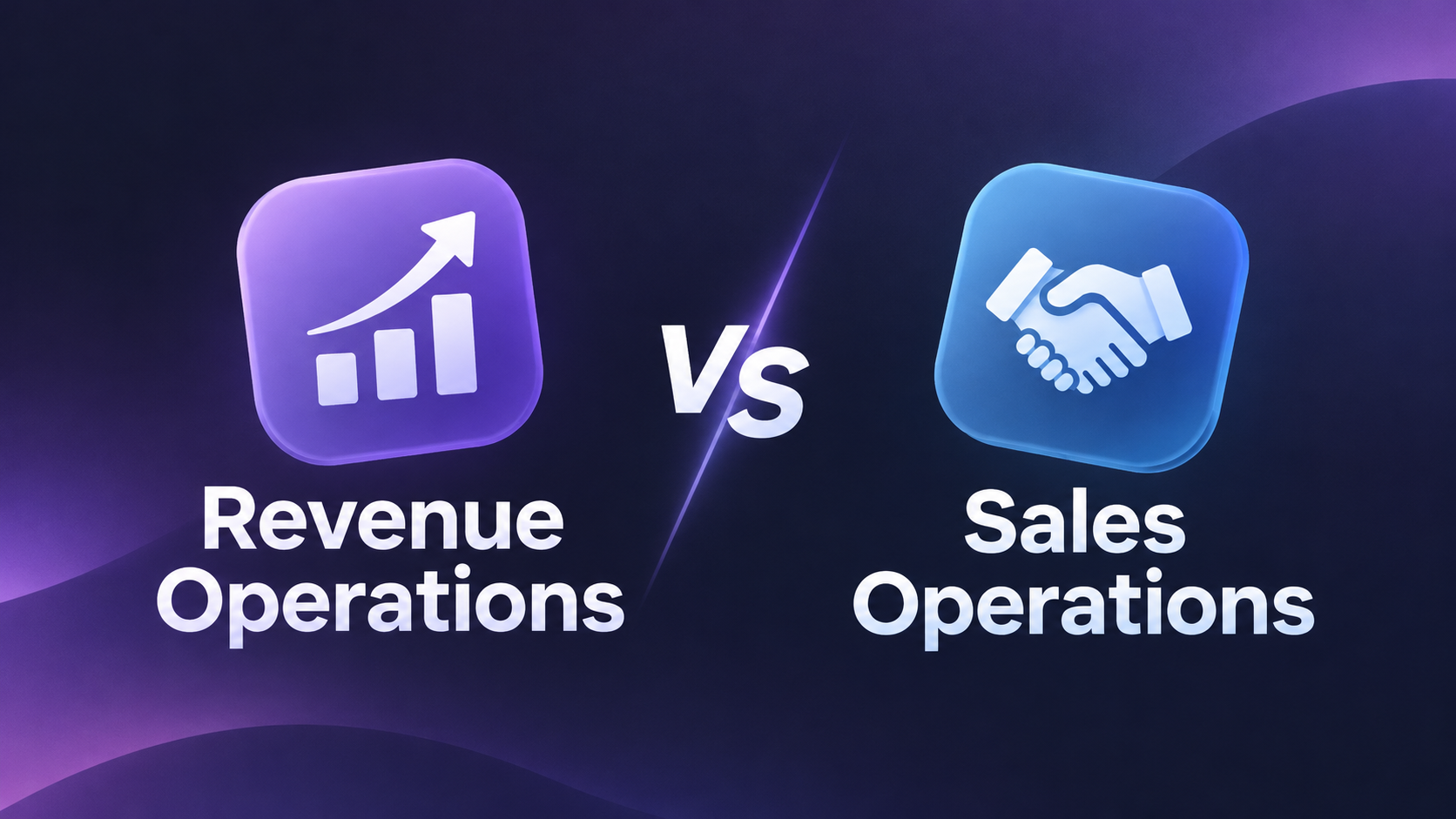
Revenue Operations vs Sales Operations: Scope, KPIs, and When to Build Each

By Olivia Hart
MyClaw Editorial
MyClaw
Run Best-in-Class AI Agents Now
Run OpenClaw or Hermes Agent on managed MyClaw hosting, so your AI agent stays online, updated, and ready for real work.
AI Takeaway
- What is the difference in revenue operations vs sales operations? Sales Ops runs the sales execution engine; RevOps aligns marketing, sales, and customer success around shared data, definitions, and lifecycle revenue.
- How do sales operations vs revenue operations KPIs and reporting lines differ? Sales Ops tracks win rate, pipeline velocity, forecast accuracy, and quota attainment under sales leadership; RevOps tracks lifecycle predictability, retention, and GTM efficiency and usually reports to a CRO, COO, or CEO.
- Which should you build first? Most companies should make Sales Ops excellent first, then add RevOps when GTM motions multiply or cross-team metrics fight each other (HubSpot, updated September 4, 2026).
- What do recent surveys and postings say? Deloitte Digital’s 2024 B2B research (via HubSpot) found firmly established RevOps orgs 1.4× as likely to exceed 2023 revenue goals by 10%+; HubSpot’s 2026 State of Sales and Gartner’s 2024 buyer survey add friction and alignment signals below.
- Where does MyClaw fit today? MyClaw hosts always-on OpenClaw/Hermes agents for pipeline hygiene, forecast digests, and CRM cleanup on the models you already use.
Revenue Operations vs Sales Operations at a Glance
| Dimension | Sales Ops | RevOps |
|---|---|---|
| Scope | Sales team execution | Full GTM: marketing, sales, and customer success |
| Stakeholders | Sales leaders, managers, and reps | Marketing, sales, success, plus finance and the C-suite |
| Revenue focus | New business: winning and closing | New business plus expansion and retention across the lifecycle |
| Primary KPIs | Win rate, pipeline velocity, forecast accuracy, quota attainment | Lifecycle performance, revenue predictability, net revenue retention, GTM efficiency |
| Tools and data | CRM, forecasting, and sales engagement for the sales org | Shared system of record spanning marketing, sales, and service data |
| Typically reports to | Sales leadership (VP Sales or CRO) | CRO, COO, or CEO, depending on maturity |
Here is revenue operations vs sales operations in one place. Sales operations (Sales Ops) builds and runs the systems reps sell with—process, forecasting, pipeline, territories, quotas, and CRM administration for the sales org. Revenue operations (RevOps) designs cross-functional revenue processes, standardizes definitions, and measures predictability across the customer lifecycle rather than one team’s output (HubSpot, updated September 4, 2026). If you typed sales operations vs revenue operations instead, you are still comparing execution depth with lifecycle breadth.

What Each Function Owns Day to Day
Sales Ops sits next to the sales floor. That means territory and quota design, stage exit criteria, forecast cadence, deal-desk and discount hygiene, and the CRM rules that keep reps out of busywork. When it works, pipeline is cleaner, commit slips less often, and managers trust the board before the weekly call.
RevOps owns the handoffs. It sets how a lead becomes sales-ready, how a closed-won account lands in customer success, and how expansion returns without a second set of conflicting fields. It also owns the shared definitions—opportunity, closed-won, qualified—so three dashboards stop telling three stories.
Marketing operations sits beside both as the campaign, attribution, and inbound engine. RevOps does not replace Marketing Ops; it governs the shared layer so marketing’s “qualified” matches what sales will work and what success will inherit (HubSpot, updated September 4, 2026).
How RevOps and Sales Ops Work Together
RevOps writes the cross-team rules and data standards. Sales Ops applies those standards inside the sales motion—forecasting, territories, and rep-facing CRM admin. They share pipeline records, handoff rules, and the CRM objects both depend on. When the split is clear, Sales Ops still exists (often as a specialty under a broader RevOps umbrella) rather than disappearing into a rename.
Blurred ownership shows up in time and trust. In HubSpot’s 2026 State of Sales report, 50% of leaders said lines among sales, marketing, and customer service are increasingly blurred, and 43% of teams spend 6 to 10 hours a month reconciling revenue data. The same report found 88% of revenue and sales leaders saying the sales process would benefit from a single integrated platform. On the buyer side, Gartner’s 2024 B2B buyer survey (cited by HubSpot) found 69% of B2B buyers encounter inconsistencies between what a vendor’s website says and what sellers tell them—usually mismatched definitions and handoffs, not a missing slide.

When marketing automation and success tooling sit next to CRM, keep those handoffs named. For marketing-side agent workflows, see AI Agents for Marketing. For the post-sale support surface renewals and expansions touch, see Best AI Customer Support Agent for SaaS.
Which to Build First: Sales Ops or RevOps
Build Sales Ops first when you are early-stage or running one primary sales motion. You need a clean pipeline, a forecast someone will defend, and reps who are not inventing process in every deal. A dedicated cross-functional RevOps layer too early adds coordination cost without enough shared complexity to govern (HubSpot, updated September 4, 2026).
Add RevOps when you run multiple GTM motions—new business plus expansion and renewal, or self-serve plus sales-led—or when marketing, sales, and success duplicate work and argue about “the” revenue number. Deloitte Digital’s 2024 B2B sales research, as cited by HubSpot, found organizations with a firmly established RevOps function were 1.4 times as likely to exceed their 2023 revenue goals by 10% or more. Read that as an outcome signal for mature alignment, not permission to skip a working Sales Ops foundation.
RevOps should not erase Sales Ops. Quotas, territories, and forecast rituals still need owners inside the sales engine. If the ops bench is thin and you only need lightweight personal tooling for now, Best Personal Assistant AI covers assistant-style helpers—not a stand-in for either function.
Salaries and Career Signals
Title and scope move pay. The RevOps Report’s February 14, 2026 comparison (job-posting ranges from public listings) says RevOps professionals often earn roughly 15–25% more at comparable levels because the work spans more teams and systems. Manager bands cited there: Sales Ops Manager about $85K–$115K versus RevOps Manager about $95K–$130K. At director level, the same piece says Sales Ops directors typically cap around $170K while RevOps directors can reach $200K+. Treat those as posted-range synthesis, not self-reported survey medians, and check your market and level before you negotiate.
Automate Pipeline and Forecast Hygiene
Org charts do not clean CRM fields by themselves. Sales Ops and RevOps both deal with stale opportunities, skipped stages, blank next steps, and forecast packs rebuilt from exports. Always-on agents can take the dull passes: flag deals with no activity past your SLA, draft a Monday forecast digest for managers, and queue duplicate or incomplete records for human review before the board deck locks.
Map those recurring jobs with OpenClaw Getting Started, and compare managed Hermes-style hosting in Best Hermes Agent Hosting. Keep people on definitions and exceptions; let the schedule carry the reminders.
Run Always-On Agents With MyClaw
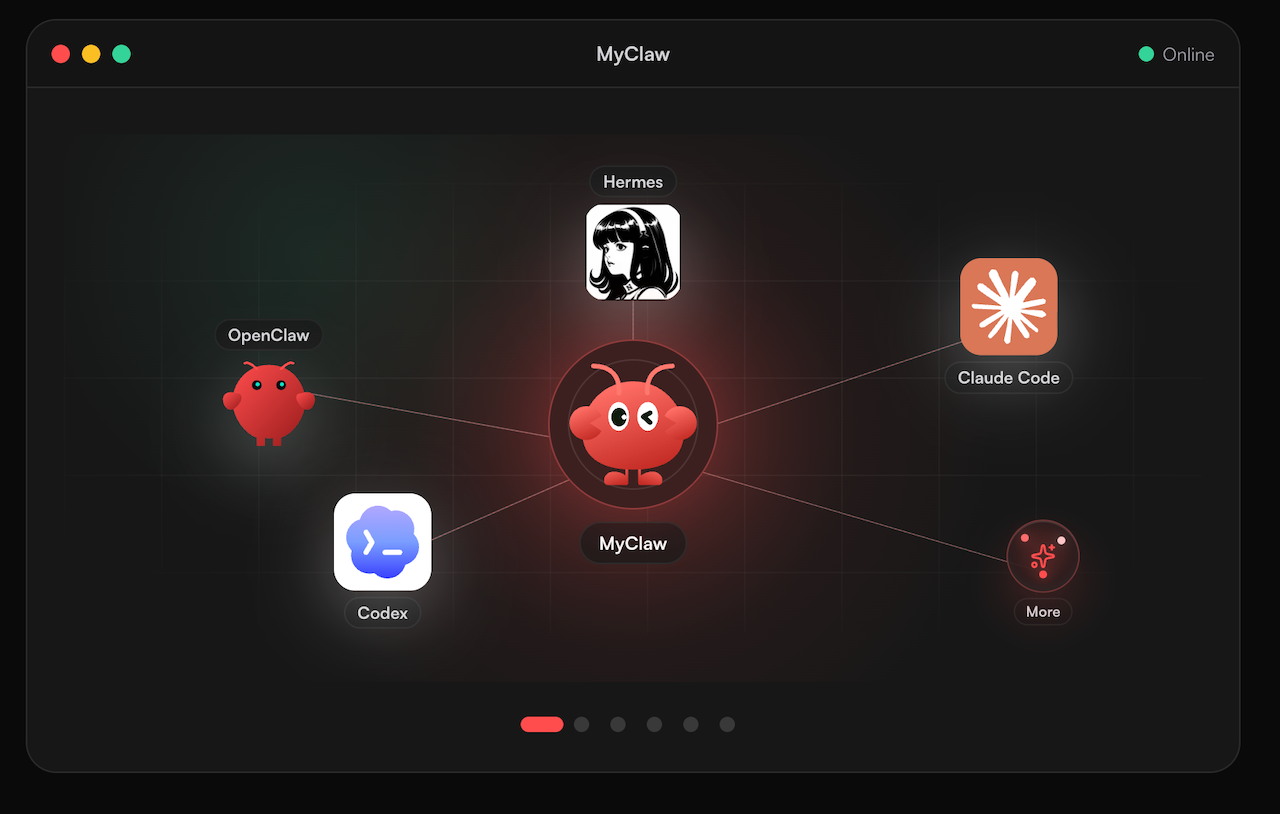
MyClaw is managed OpenClaw/Hermes agent hosting: always on, scheduled jobs, no server for you to babysit. It works with most popular models. For what the OpenClaw stack is, read What Is OpenClaw.
A Sales Ops lead can park an overnight pipeline hygiene run that lists opportunities stuck in the same stage too long or missing a next meeting, then drops the list in chat before standup. A RevOps owner can schedule a weekend CRM cleanup pass—duplicates, blank required fields, mismatched owner and territory—and a Monday morning forecast digest that reconciles commit versus pipeline so the weekly call starts from one sheet. Connect the models and CRM skills you already have permission to use; expand later when the jobs are stable.
- Create a MyClaw workspace and connect the models and skills you are already authorized to use.
- Define the recurring work—pipeline hygiene, forecast digests, CRM cleanup—and attach schedules so the agent keeps running after you close the laptop.
- Review logs and tighten prompts or tools as the jobs stabilize; change models only when you are ready to re-validate the same checks.
Hygiene can still run at 3 a.m. while you decide whether the next hire is Sales Ops depth or RevOps breadth.
Conclusion
Revenue operations vs sales operations is about scope and ownership, not a rebrand. Sales operations vs revenue operations asks the same question from the other direction: keep a reliable sales engine, then connect marketing and customer success with shared definitions and lifecycle metrics. Build Sales Ops first, add RevOps when cross-GTM friction shows up, keep both when the model works, and cite survey and posting figures with their dates. Put always-on pipeline, forecast, and CRM checks on MyClaw with OpenClaw/Hermes so the ops work continues while the org chart catches up.
Skip the Setup, Run Best-in-Class AI Agents Now
Launch a managed OpenClaw or Hermes Agent workspace in minutes, with always-on hosting, updates, and support handled by MyClaw.