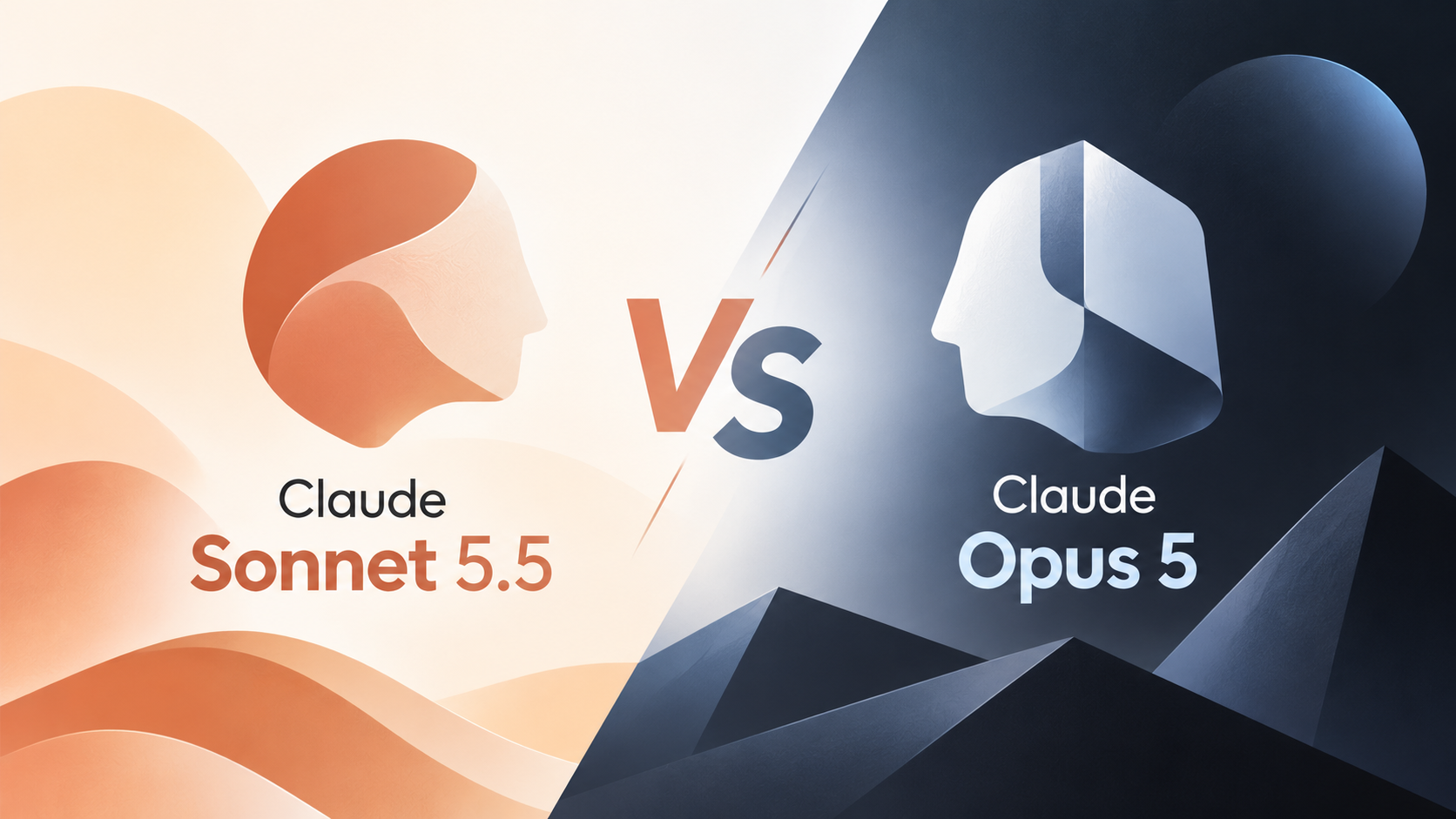
Claude Sonnet 5.5 vs Opus 5: Price, Coding & Best Fit

By Nathan Cole
MyClaw Editorial
Compare in MyClaw
Compare Claude Sonnet 5.5 and Claude Opus 5 on your own work
Give both models the same task and compare the results, speed, and usage.
AI Takeaway
- Which should you try first? Start with Sonnet 5.5 for scoped everyday work. Test Opus 5 when a task is ambiguous, demanding, or long-running.
- How much cheaper is Sonnet 5.5 by token? Anthropic lists it at $2 per million input tokens and $10 per million output tokens, versus $5 and $25 for Opus 5. At equal token volume, Sonnet 5.5 costs 60% less.
- Does that make it better value for every task? No. Compare cost and quality per completed task, including retries and tool calls.
- Is there a universal benchmark winner? No. Anthropic has shared a direct but narrow app-building comparison; it does not settle every workload. Test the tasks you actually run.
Sonnet 5.5 vs Opus 5 at a Glance
This is a cross-release comparison: Anthropic announced Sonnet 5.5 on September 28, 2026, and Opus 5 on July 24. Opus 5.5, released September 22, is a separate model. If you specifically need to compare Sonnet 5.5 with Opus 5, these are the listed API rates and typical task fits:
| Claude Sonnet 5.5 | Claude Opus 5 | |
|---|---|---|
| Starting point for | Defined everyday tasks, coding fixes, polished documents | Complex, ambiguous, multi-step work |
| Standard API input rate | $2 / million tokens | $5 / million tokens |
| Standard API output rate | $10 / million tokens | $25 / million tokens |
These are API list rates, not Claude subscription prices. At the same token volume, Opus 5 costs 2.5 times as much. The full task bill can differ if one model uses more context, output, or retries. MyClaw's guide to the best model for OpenClaw explains why workload fit matters more than choosing one model as a universal default.
Where Sonnet 5.5 Is the Better Fit
Sonnet 5.5 is a sensible first test when the job is clear and you can check the result. Anthropic positions it for well-scoped everyday work, bug fixes, and polished documents, slides, and spreadsheets. Its lower token rates also make repeated calls easier to budget.
For coding, Anthropic reports a useful but limited comparison: in 118 app builds, Base44 found Sonnet 5.5 produced scores on par with Opus 5, averaging 3.6 iterations per build versus Opus 5's 7.7. That is one company's evaluation of app-building work, not a general benchmark across coding tasks. It supports testing Sonnet 5.5 on bounded implementation jobs; it does not prove it will match Opus 5 on every repository or agent workflow.
Choose Sonnet 5.5 for a scoped code change, a first-pass review, or a structured report when it meets your quality bar without extra supervision. The earlier Claude Sonnet 5 model guide can provide background on the previous generation, but its specs and prices do not apply to Sonnet 5.5.
When Opus 5 May Be Worth the Premium
Opus 5 is worth testing when the hard part is judgment rather than producing a quick first answer: investigating a failure across a codebase, weighing competing evidence, or keeping a long sequence of agent actions on track. A better result can justify a higher token rate if it avoids an expensive mistake or repeated human intervention.
That is a reason to test Opus 5, not a guarantee it will win. Even a capable model can spend too long checking a simple request or take an approach that does not fit your workflow. Give it a clear goal, boundaries, and a definition of done. MyClaw's Claude Opus 5 review covers its strengths, costs, and limits.

What the API Price Gap Means for a Real Task
At equal usage—100,000 uncached input tokens and 10,000 output tokens—the listed rates work out to about $0.30 with Sonnet 5.5 and $0.75 with Opus 5. That is a 60% difference for the same token volume. Treat it as an illustration, not a forecast of either model's cost for a real task.
An agent run may use different amounts of context, reasoning, output, and tools; it may also need retries. Track the whole run rather than multiplying one prompt by the rate card. MyClaw's guide to cutting OpenClaw token costs covers other ways to control recurring usage.
How to Choose Between Sonnet 5.5 and Opus 5
Use Sonnet 5.5 as the first candidate for repeatable jobs with clear inputs and checks. Try Opus 5 for open-ended work with several dependent steps, especially when errors are expensive. If neither clears your quality bar, test another model available through your provider instead of choosing by tier name alone.
For a fair comparison, give both models the same representative task, source material, tools, and acceptance criteria. Record:
- Whether the result is correct and complete
- Time to a usable result
- Retries and tool calls
- Total API usage for the completed run
Repeat the test on several tasks before changing a production workflow. Benchmarks can narrow the candidates, but scores reflect specific prompts, tools, and evaluation rules. The best model for your agent is the one that meets your bar at an acceptable cost and level of oversight. If different workflows need different instructions or tools, MyClaw's OpenClaw multi-agent guide covers how to separate those roles.
Compare Both Models in a Managed OpenClaw Workflow
A repeatable agent workflow can expose differences that a one-off chat misses. MyClaw offers managed OpenClaw hosting for persistent agent work. Model availability depends on the provider and configuration, so first confirm that your route exposes both models.
- Choose one real task. Write down the inputs and what a correct result must include.
- Run both models. Keep the task, source material, and available tools the same.
- Compare the completed runs. Check correctness, elapsed time, retries, tool calls, and API usage; use the lower-cost model where it meets your bar.
The Practical Verdict: Start With the Cheapest Model That Passes
For scoped, repeatable work, try Sonnet 5.5 first and keep it where its results are reliable. For complex tasks where better judgment or fewer failures could matter more than token price, test Opus 5 against the same standard. Decide from completed work and real usage, not the model name alone.
Compare in MyClaw
Compare Claude Sonnet 5.5 and Claude Opus 5 on your own work
Give both models the same task and compare the results, speed, and usage.